On the polysemanticity of the V neuron
A widely shared essay argues that InceptionV1's most famous polysemantic neuron is really a clean V-shape detector. We tested that claim, with pre-registered predictions, on the neuron and on its main input.
Neural Networks Are Already Clean (Goodfire, 2026) has been all over X. It argues that the neurons of modern networks are mostly understandable as they are, and that the field's long-standing worry, that neurons pack unrelated concepts together, came from ordinary, fixable problems: older architectures, weak tools and misread famous examples.
It is also long (the page puts it at 65 minutes) and hard going if you don't already work in interpretability. It uses the field's vocabulary from the start and defines it on its own terms as it goes: polysemanticity gets a one-line gloss, recursive generalization is defined when its section arrives, and superposition is narrowed partway through to the essay's own sense, which it says differs from the field's usual one. That sets a high barrier to entry. And the term this post is about, the "V", is never defined precisely.
That points to a pattern common in interpretability research: sweeping claims about how neural networks work, generalized from narrow behavior seen in a few experiments. Narratives like this are hard to challenge. They arrive as walls of examples and visualizations that feel overwhelming, and they lean on other work presented in the same way, even when the conclusions rest on a handful of small analyses/human observations.
Rather than arguing with the essay as a whole, we should be checking its foundations: the experiments it rests on. Luckily, rerunning and extending those experiments has become much easier and faster with coding agents, as long as a human supervises the work closely. This post does that for one of them, the reinterpretation of the "V neuron", tested with predictions written down in advance, on thousands of images rather than a few.
A cat-and-car neuron, or a V detector?
InceptionV1 is a 2014 image classifier that became interpretability's first model organism. People call a neuron monosemantic when it responds to one thing, and polysemantic when it seems to respond to several unrelated things. InceptionV1's neuron 4e:55 (the "V neuron" in the essay) was the textbook polysemantic case: it fires for cat faces and for the fronts of cars.
The essay rereads it. In its words, "it's not a cat and car neuron, it's a V-shape neuron": pointed things drive it, round things push it negative. The evidence offered is the images that activate it most, the units it connects to, and a few photos of pointed and round objects. Its largest input, 4d:493 ("fox snout"), supplies about a third of its drive. The essay makes no shape claim about 4d:493 itself, but it is the obvious place for 4e:55's V-ness to come from, so we test it too. The essay uses this neuron as a main example of polysemanticity that was simply misread.
None of that evidence separates shape from content: the top images are correlational, and the essay's ablations change the network, not the image. In natural photos, shape and category travel together: cat faces, fox snouts and car fronts are often V-ish, while golf balls and clocks are round. A neuron that responds to cat faces and car fronts would show the same top images as one that responds to V shapes. To tell the two apart, you have to change one while holding the other fixed.
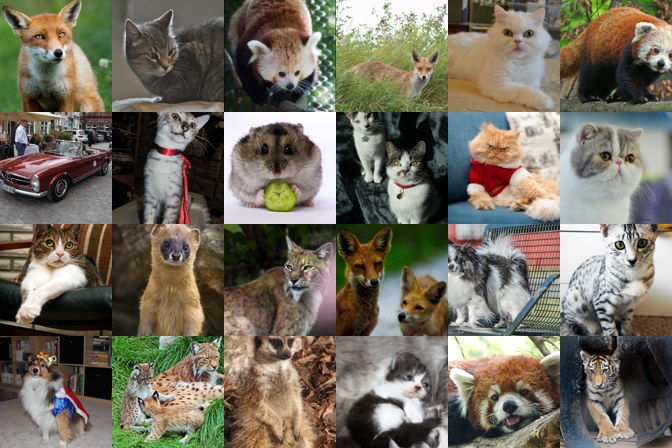
Two readings, then, with different predictions:
- Shape (the essay's): the neurons detect converging contours that meet at a point, whatever the object. Shapes alone should drive them, a sharp point should beat a rounded one, and an object's outline should carry most of the response.
- Content (the older cat-and-car reading): the neurons respond to what's inside the outline, such as fur, eyes, snouts and grilles. Removing the inside should remove the response. And if we show the image only through a window, a mask that crops it to a given shape, the window's shape should matter little once the face is visible.
How we tested it
Each test pulls shape and content apart in a different way:
- Shapes alone. Textured silhouettes (a V, a rounded V, an ellipse and a disk of equal area) with no animal or car photo in them.
- Outline versus inside. The neurons' strongest photos, with the object's exact outline kept and everything inside it wiped out.
- Windows. The same face seen through windows of different shapes but equal area.
- Wiring. Each neuron is a weighted sum of the layer below, so every response splits exactly into contributions from individual inputs. That shows whether cats and cars arrive through the same inputs.
- Real photos. Pointed-faced and round-faced breeds, grouped by breed standard before measuring.
Throughout, a neuron's output is scaled so that 1.0 is what it gives a typical top photo. Before testing, we searched for each neuron's favorite V shape (apex angle, orientation and size) and froze it, to give the shape reading its best shot. That was a wide 120° wedge pointing down for 4e:55 (V neuron), and a narrow 30° wedge pointing left for 4d:493 (fox snout): a snout in profile. The tests used thousands of everyday photos across all 1,000 ImageNet categories, plus about 7,000 pet photos with outlines and face boxes.
Pre-registration
We ran two studies: one on 4e:55 (V neuron), then one on 4d:493 (fox snout). Each put its neuron through the same five tests. The second study also fixed a design flaw the first one exposed: in Test 3, the windows were too small to show the face.
Both studies were pre-registered. Before running anything, we wrote down the stimuli, the measurements, the thresholds, and the decision rules: which results would count as support for the shape reading, which as a refutation, and which as mixed. Each document was hashed and timestamped before its tests ran. Every pre-registered result is reported, including those that favor the essay. The handful of deviations are logged with reasons: a missed sub-criterion in an identity check, two construction bugs caught on a stand-in neuron before the real run, and two clarifications.
Pre-registration turns a handful of illustrative examples into a test of a hypothesis on hundreds or thousands of images, with success defined in advance. It also takes away the analyst's freedom to choose, after seeing the data, the comparison that looks best. That freedom is what makes a single striking example so persuasive.
The study design and the experiments were orchestrated by a human. The implementation (stimuli, measurements and analysis) was written with Claude Opus 5.5 and checked by a human. The code, the raw results, the full pre-registration documents and their outputs, and a more complete report are all on GitHub.
Shapes on their own
If these neurons detect a V, a V on its own should drive them. Each neuron sees its favorite wedge, a rounded version of it, an ellipse and a disk of the same area, filled with a texture or with fur, with or without a pair of eyes.
Neither neuron responds much to shapes without content. Their best wedges reach about a tenth of a typical photo: 0.12 for 4e:55 (V neuron) and 0.10 for 4d:493 (fox snout). The pre-registered bar for a strong response was 0.3. Shape does matter in relative terms: the V drives 4e:55 about 5× and 4d:493 about 4× as strongly as an equal-area disk. For 4e:55 the sharpness of the point doesn't matter: the rounded V scores 0.11 against the V's 0.12. 4d:493 does prefer a sharp point, by +0.05 over the rounded V and +0.04 over the ellipse. That's real, but small. Eyes on a disk change nothing; on a fur-filled wedge they lift 4e:55 to about 0.21, still below the bar, and barely move 4d:493.
TakeawayShape matters in relative terms, since a V beats a disk, but on its own it is a weak driver of both neurons. Whatever makes them fire at full strength isn't in these silhouettes, and only 4d:493 shows a hint of preferring a sharp point.
Outline versus inside
If a neuron detects a V, an object's outline should carry its response. So we keep the object's exact outline and wipe out everything inside it, or keep the object and wipe out the background instead.
Across each neuron's 200 strongest photos, the response collapses once the inside is gone. On average 4e:55 (V neuron) keeps 15% with the inside flattened and 11% with it scrambled; 4d:493 (fox snout) keeps 10% and 8%. Editing the background instead leaves 97% to 99%.
TakeawayThe inside of the object (fur, eyes, a grille) carries almost all of the response. The outline alone, the very thing a V detector should see, keeps about a tenth.
Same face, different windows
Windows hold the content fixed and change only the outline: the same face seen through a V, a rounded V, an ellipse or a disk, all with the same area.
For 4e:55 (V neuron), the pre-registered windows were small, showing about 18% of the face. There the V-shaped window beat the disk on cat faces (+0.14), dog faces (+0.15) and car photos (+0.20), though not on the neuron's own top animal photos (−0.04). This was the strongest pre-registered result in the essay's favor, with a shape share of 0.70 for cat faces. But with most of the face hidden, much of what remains is the window's own outline, and Test 1 showed that any wedge drives the neuron a little.
For 4d:493 (fox snout) we sized the disk to the face circle, so the whole face is visible, and gave the other shapes the same area. The shape preference then goes away. On cat faces the disk beats the V (0.52 vs 0.42); on dog faces the V leads by only +0.03.
TakeawayWhen the window hides the face, a V-shaped window helps. When the window shows the face, its shape stops mattering. Only 4d:493's study was designed to show the face, so for 4e:55 this test can't separate the two readings.
Wiring: which inputs carry cats and cars
Each neuron's response is a weighted sum over the layer below: 528 inputs for 4e:55 (V neuron), 512 for 4d:493 (fox snout). So for any photo, the response splits exactly into how much each input contributed. If 4e:55 detects one shared V pattern, cat photos and car photos should reach it through the same inputs. If it reads two kinds of content, they should arrive by different paths.
With cats against vehicles, the largest input for both is 4d:493 (fox snout): 38% of the cat response and 19% of the car response. Beyond it the paths split, with cat photos coming in through cat-, hamster- and fox-face inputs and car photos through car-front and grille inputs. The pre-registered routes (the smallest sets of inputs carrying half of each group's response) have 4 inputs for cats and 7 for vehicles and share only 4d:493, but it is large enough that the car route still carries 0.82× as much of the cat response as the cat route does. V shapes lean on 4d:493 too (14%), take about 7% through the car inputs and almost nothing (1%) through the cat ones. In 4d:493 itself, cats, dogs and foxes share many inputs, and vehicles drive it at about half the cats' level (0.23 vs 0.42 on average), with a van-like input as their largest single source (14%).
Takeaway4e:55 is wired like two category routes, small furry faces and car fronts, joined at one large shared input, rather than one shape detector fed by V-like inputs. That shared input, 4d:493, is itself fed mainly by animal-face channels.
Pointed and round faces in real photos
If pointedness drives these neurons, pointed-faced breeds should beat round-faced ones. For cats it goes slightly the other way: round faces score a little higher for both neurons (−0.07 and −0.04, pointed minus round). The round-faced Persian is the #2 category, out of 1,000, for 4e:55 (V neuron). For dogs, pointed breeds score higher on average (+0.09 and +0.14). But the flat-faced Japanese chin tops both neurons, and the pointed, short-coated miniature pinscher sits near the bottom.
Objects show a similar picture. Before measuring, we listed pointed objects the essay doesn't mention (guitar picks, missiles, speedboats, canoes, spires, volcanoes, peaks) and round ones (balls, clocks, plates, oranges, airships). For 4e:55 (V neuron) the pointed ones lean high (median rank #284 of 1,000), but on average they score about the same as the round ones (0.17 vs 0.14, a difference within noise). The essay's own examples rank #32 (pool table), #43 (bullet train) and #489 (fireboat).
TakeawayOn its own, pointedness predicts little: round-faced cats rank near the top, the dog effect tracks coat as much as head shape, and pointed objects chosen in advance do no better than round ones.
What this does and doesn't show
| Neuron | Pre-registered verdict | Pre-registration |
|---|---|---|
| 4e:55 (V neuron) | Mixed. Shapes and outlines alone drive it weakly, and its inputs split by category, but its small-window test leaned toward the V. No rule for support or refutation was met. | 411def |
| 4d:493 (fox snout) | Pointed account refuted; content account supported. Weak shape responses, collapse without the inside, and no shape advantage once the face is visible. The essay makes no shape claim about this unit; the test asks whether 4e:55's V could come from it. The result fits the essay's own "fox snout" label. | 008a77 |
These are results for two neurons in one network, with automated edits and our own operationalization of "V", which the essay never defines precisely. They don't show that the V is a useless way to describe what these neurons' top images have in common. They show that when shape and content are varied separately, shape explains a small part of what drives either neuron.
We're not claiming this proves or disproves the essay's larger thesis about how neural networks are organized, and that is exactly the point. Our tests support narrow conclusions about two neurons, which is also all the original V-neuron analysis could support.
Does this matter for interpretability?
Is neuron-level interpretability solved? No. Is it the one thing we need to be confident in a neural network's decisions? Probably not (personal opinion), but it's too early to tell.
What I think is desperately missing right now is interpretability with skin in the game, in the spirit of prediction markets, where a claim is worth what it delivers. If we use concepts like the V neuron to build guardrails, are those guardrails observably robust? If we use them for unlearning, does the concept actually go away, and does the model behave better for it? Do these interventions lead to better outcomes than the alternatives? A compelling narrative can't answer those questions on its own, and they are the ones that would tell us what these stories are worth.
@misc{eiras2026vneuron,
  author = {Eiras, Francisco},
  title  = {On the polysemanticity of the {V} neuron},
  year   = {2026},
  url    = {https://fgirbal.github.io/blog/v-neuron-polysemanticity/}
}